Kata Tjuta by Helicopter or on Foot: Which Is Worth Your Money?
Short answer. Fly if you are short on days, cannot walk far, or want the whole formation in one view. Walk if you want to feel the scale, which only happens with a rock wall on either side of you. They are not substitutes, and the honest answer for most people with two days is to do one of each.
The short answer
The flight is the only way to see all thirty-six domes as thirty-six. The walk is the only way to understand how big any one of them is. If you have to pick, pick on which of those two you came for — not on price, because the gap is smaller than it looks once the park pass goes on the walking side.
Side by side
| The sunset flight | The half-day walk | |
|---|---|---|
| Time it takes | 36 minutes airborne, about 2 hours door to door | 3 to 5 hours door to door, including 90 minutes of driving |
| What it costs | $298 a head | $133 to $151 a head, plus the A$38 park pass |
| What you see | All 36 domes, the western face of Mount Olga, Walpa Gorge and the Valley of the Winds from above | The inside of one gorge, at the scale of the walls |
| Park pass needed | No | Yes, and both half-day listings exclude it |
| Walking involved | None | 2.6 km on a rocky graded track, about an hour |
| Weather risk | Cloud can take the sunset; the flight still goes | Heat closes the long walk at 11:00 am; the gorge stays open |
| What it will not do | Fly directly over or completely around either formation | Show you more than four or five domes at once |
The case for flying
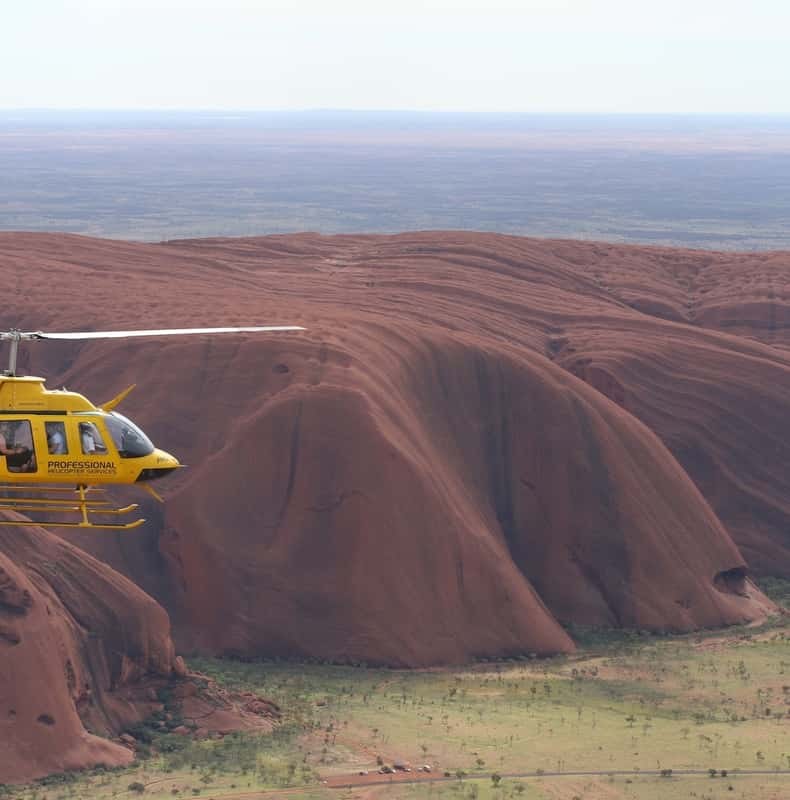
From the road you see four or five domes. From the air you see the formation for what it is: thirty-six heads spread over more than twenty square kilometres, with the valleys between them shadowed and Uluru sitting on the horizon behind.
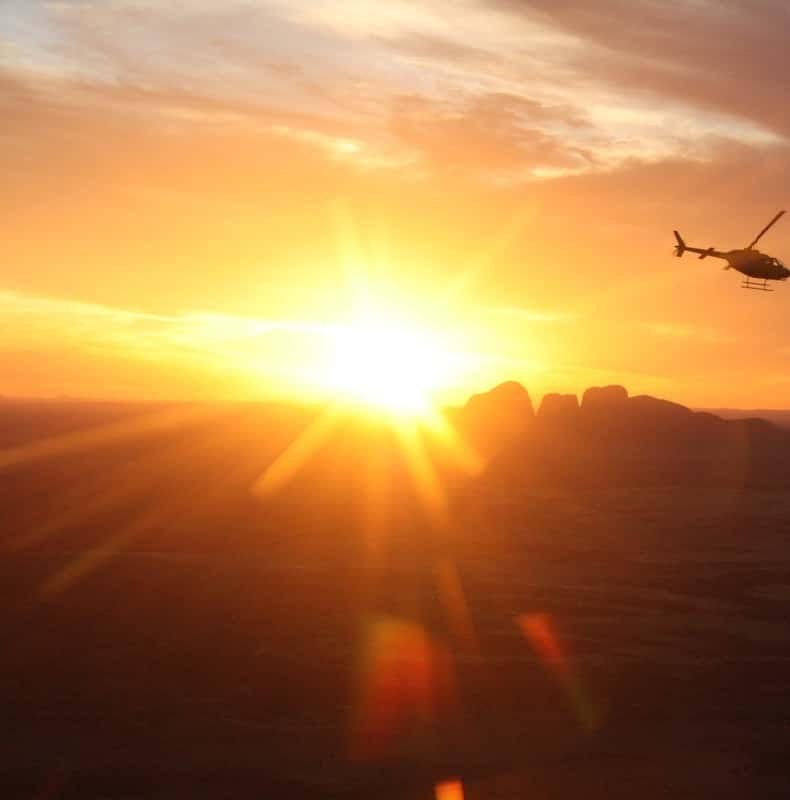
The thirty-six minute sunset flight runs out past Uluru, down the western face of Mount Olga and along Walpa Gorge with the Valley of the Winds opening below. It needs no park pass, no fitness and no early start, and it is over in about two hours door to door.
The case for walking
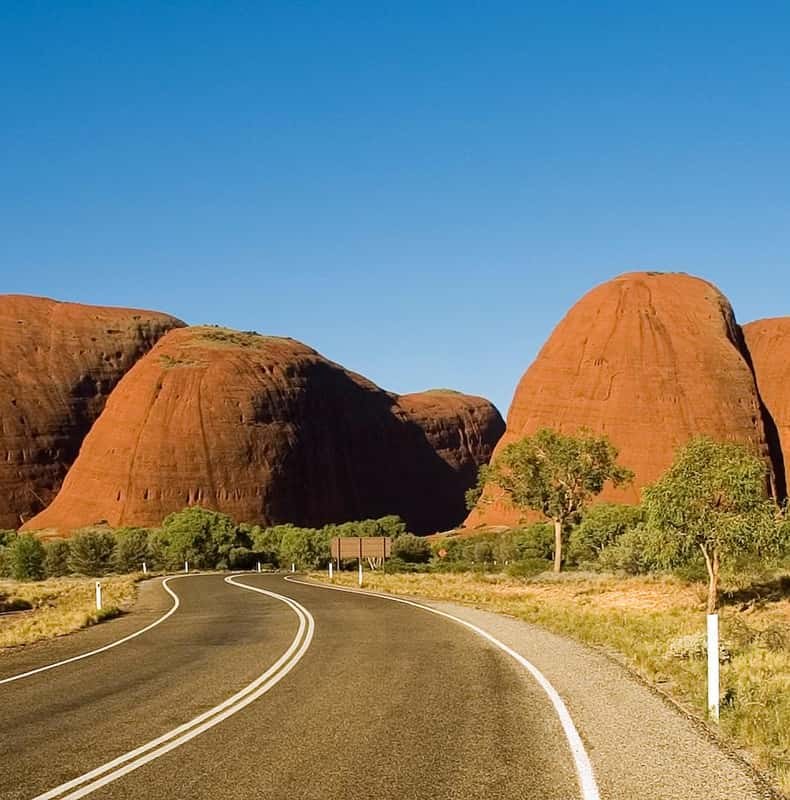
Scale is the thing photographs never carry, and it only arrives when there is several hundred metres of rock on either side of you. Walpa Gorge does that in an hour: 2.6 km return on a graded but rocky track, in between two of the tallest domes, ending at a grove of spearwood.
You also get the things a flight cannot show — the rare plants in the gorge, the seasonal stream, the kanyala in the rocks, and a guide explaining why the rock looks like a plum pudding up close. Reviewers keep saying they arrived expecting rocks and left understanding how the formation was made.
The thing both flight operators say they will not do
Neither aircraft flies directly over the formations. Both helicopter listings state that the flights do not fly directly over nor completely around Uluru or Kata Tjuta, due to the cultural sensitivity of the feature. That is a restriction rather than a routing choice, and it is the same principle that closes areas on the ground. You get the flank and the spread, which for a formation this wide is arguably the better view anyway.
What each one actually costs
The flight is $298 a head and needs nothing else. The half-day walking departures run $133 to $151, and both exclude the national park pass, which is A$38 for three days. So the walking side is roughly $160 to $180 once you have paid for entry — still less than the flight, but not by half.
The one caveat on the flight is the minimum: two passengers, so a solo traveller is paired with another booking rather than flying alone. The scenic flights page compares all three of them.
What about the fifteen-minute flight?
There is a third option and it is worth ruling out explicitly. The fifteen-minute helicopter from the same operator circles Uluru and does not reach Kata Tjuta at all. It is $140 against $298, which looks like a saving until you notice it is a flight over a different landmark.
If Uluru from the air is what you want, take it. If the domes are why you are reading this, it is not a cheaper version of the sunset flight, it is a different product. The twenty-five minute flight sits between the two and does reach the domes, so it is the real middle option.
What neither of them gives you
Neither the flight nor the half-day walk puts you in the Valley of the Winds. That 7.4 km circuit takes about four hours on Grade 4 track and no half-day departure makes room for it — only two of the multi-day itineraries do.
So if the long walk behind the domes is the thing you have read about and want, the decision is not flight-or-gorge at all. It is whether to take a multi-day itinerary or to hire a car and do it yourself, which the self-drive guide works through with the arithmetic.
Doing both
This is what most people with two nights at Yulara should do, and the order matters. Walk first, on the afternoon or morning departure, so you have a sense of the scale. Then fly at sunset on the second day, when the shapes you walked between are laid out below you and the light is doing its best work.
The reverse order works too but it wastes something: the flight makes more sense once you know how big the gorge is, and the gorge is less surprising once you have seen the whole thing from above.
Booking either one
The refund windows differ and it is worth knowing which you are agreeing to. The sunset flight refunds in full up to 24 hours ahead. The three-hour afternoon walk wants three days’ notice, which is longer than most people assume and long enough that a change of forecast will not save you.
The flight also carries a two-passenger minimum, so a solo traveller is paired with another booking rather than flying alone. And on the walking side, remember the park pass is excluded from both half-day departures: buy it online before you travel, because a departure will not wait at the entry station.
The verdict, by visitor
- One afternoon and you came for the domes — walk. The three-hour small-group tour spends all of it at Kata Tjuta.
- One morning and you want both formations — walk, on the sunrise day trip, which adds Uluru at first light.
- Mobility is the constraint — fly. Neither track is wheelchair accessible and the long one has many steps.
- Two nights and a budget — do both, in that order.
Kata Tjuta helicopter tours are set out with what each fare covers, and Kata Tjuta Tours has all of them in one grid.
If you have the morning, walk it. If you have thirty-six minutes, fly it.Every tour here refunds in full; each card states its own window.
See the departuresOne of each, to compare
From Yulara: 3-Hour Small Group Kata Tjuta Afternoon Tour
Guided walkingPickup includedMax 15
From $133 per person